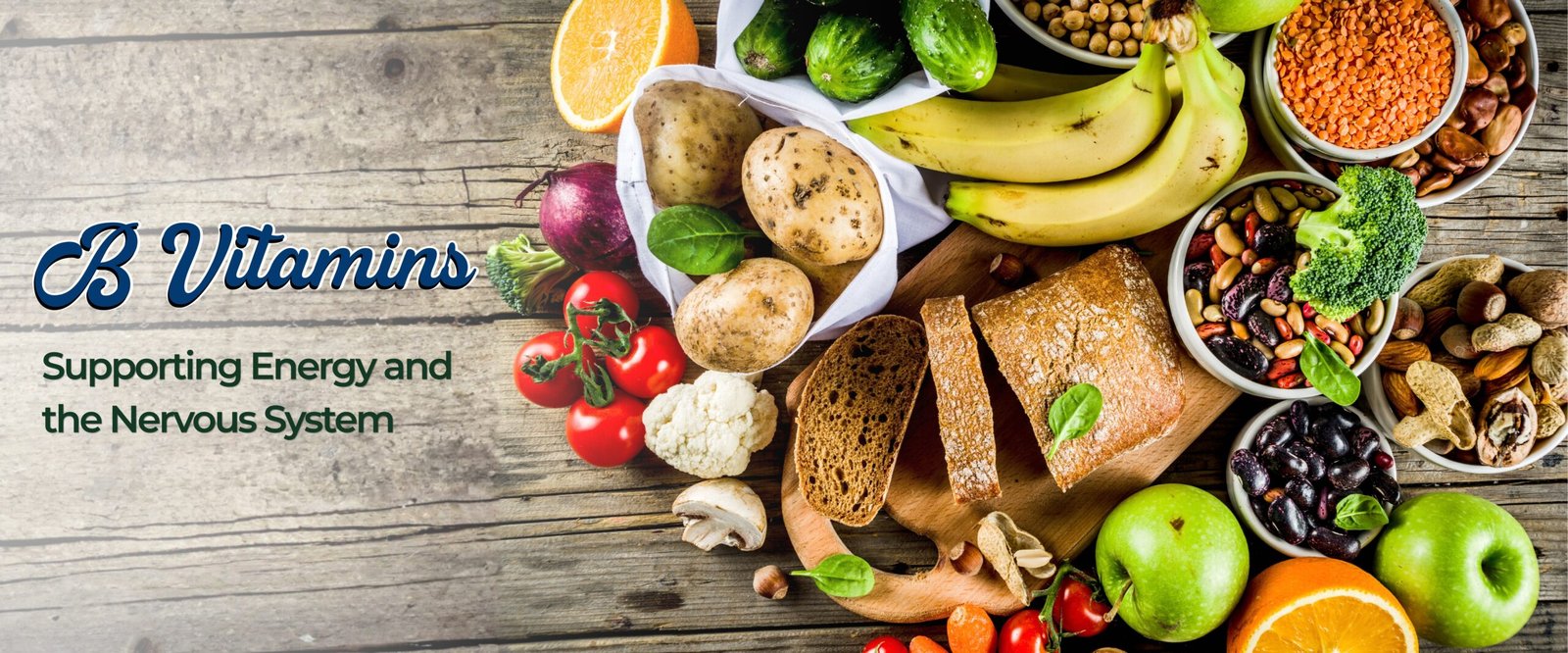
B Vitamins: Supporting Energy and the Nervous System
B vitamins are among the most important nutritional components to consider when discussing energy and
cognitive wellness.
The B-complex family includes:
- Vitamin B1
- Vitamin B2
- Vitamin B3
- Vitamin B5
- Vitamin B6
- Vitamin B7
- Vitamin B9
- Vitamin B12
These vitamins perform different functions throughout the body.
Vitamin B1
Thiamine is involved in normal energy metabolism and nervous-system function.
Because the brain depends heavily on a continuous energy supply, nutrients involved in energy metabolism
are important components of overall cognitive wellness.
Vitamin B2
Riboflavin participates in energy production and other cellular processes. It also contributes to the body’s
normal antioxidant systems.
Vitamin B3
Niacin is involved in energy metabolism and normal cellular function. It is another example of a nutrient that
supports fundamental physiological processes rather than acting like a stimulant.
Vitamin B5
Pantothenic acid contributes to energy metabolism and the synthesis of important compounds in the body.
Vitamin B6
Vitamin B6 participates in numerous enzymatic reactions, including those associated with protein metabolism
and normal nervous-system function.
Folate
Folate is important for DNA synthesis and cell division. Adequate folate is particularly important during
pregnancy, which is one reason nutritional needs can change significantly across life stages.
Vitamin B12
Vitamin B12 is particularly relevant to healthy aging and neurological function. B12 contributes to normal red
blood cell formation and nervous-system function. Some older adults can have difficulty absorbing naturally
occurring B12 from food, making nutritional assessment particularly relevant with advancing age.
The broader message is simple:
B vitamins help support the biological processes that allow the body and nervous system to function
normally.
They should not, however, be presented as instant energy boosters or treatments for chronic fatigue.
Vitamins A, C, D, E and K: More Than Just “Immune Vitamins”
When people think about vitamins, they often focus on individual benefits.
But vitamins work as part of a larger nutritional network.
Vitamin A
Vitamin A contributes to normal vision, immune function and cell specialization. Adequate vitamin A is
therefore relevant to both general wellness and long-term nutritional health.
Vitamin C
Vitamin C is a well-known antioxidant nutrient.
It contributes to normal immune function and helps protect cells from oxidative stress. It also supports
collagen formation, which is important for connective tissues. Foods such as citrus fruits, guava, amla, peppers
and many vegetables can provide vitamin C.
Vitamin D
Vitamin D is important for calcium absorption and normal bone health. It also contributes to normal immune
function and muscle function. Vitamin D becomes particularly relevant as adults age because maintaining bone
and muscle health is an important part of healthy aging.
Vitamin E
Vitamin E contributes to antioxidant protection. It helps protect cells from oxidative stress and is commonly
found in nuts, seeds and plant oils.
Vitamin K
Vitamin K is involved in normal blood clotting and bone metabolism. Vitamin K deserves special consideration
for people taking certain anticoagulant medications. The NIH advises people taking warfarin and similar blood
thinners to discuss vitamin K-containing supplements with their healthcare provider.
Minerals for Brain-Body Balance
Vitamins often receive the most attention in supplement marketing, but minerals are equally important.
A broad-spectrum nutritional approach may include minerals such as:
- Calcium
- Magnesium
- Iron
- Zinc
- Copper
- Manganese
- Selenium
- Iodine
- Chromium
- Boron
- Molybdenum
Each has different functions.
Magnesium
Magnesium is involved in numerous physiological processes and contributes to normal nerve and muscle
function. It also participates in energy metabolism. Magnesium-rich foods include nuts, seeds, legumes, whole
grains and leafy green vegetables. While magnesium is often marketed as a “stress-relief” mineral, it is more
accurate to describe it as an essential nutrient that supports normal physiological function. If dietary intake is
inadequate, improving magnesium intake may be useful.
Zinc
Zinc contributes to normal immune function, DNA synthesis, cell division and many enzymatic processes. It is
also relevant to normal reproductive and metabolic health. For men and women alike, adequate zinc intake is
part of maintaining nutritional health.
Iron
Iron plays a central role in oxygen transport and normal energy metabolism. Iron is particularly relevant for
many women during the reproductive years because menstrual blood loss can increase iron requirements.
However, iron is not a nutrient everyone should supplement indiscriminately. Excess iron can be harmful, and
people should consider their dietary intake and individual needs before using additional iron.
Calcium
Calcium is essential for maintaining normal bones and teeth and also contributes to normal muscle function.
As adults age, bone health becomes increasingly important. Calcium works in combination with other
nutrients, particularly vitamin D, rather than functioning as an isolated “bone supplement.”
Selenium
Selenium is a trace mineral involved in antioxidant defense and normal thyroid and immune function. It is
required in relatively small amounts, which is another reminder that more is not necessarily better.
Copper and Manganese
Copper and manganese are trace minerals involved in enzymatic reactions, connective-tissue metabolism and
antioxidant-related processes. Although they receive less attention than calcium or magnesium, they
contribute to the broader nutritional picture.
Iodine
Iodine is essential for the production of thyroid hormones. Because thyroid hormones influence metabolism
and numerous physiological processes, adequate iodine is an important component of nutritional health.
Chromium
Chromium is often included in formulations positioned around metabolism. It is involved in insulin action,
although claims about chromium supplements producing major changes in weight or blood sugar should be
treated cautiously.
Antioxidants and Cellular Protection
The term “antioxidant” appears frequently in wellness marketing. But what does it actually mean?
Normal metabolism produces reactive molecules, while the body has systems that help maintain balance.
Nutrients and plant compounds can contribute to antioxidant defences. Vitamins C and E, selenium and other
nutrients are involved in these processes.
Some nutritional formulations also contain plant-derived antioxidant compounds such as:
- Amla
- Grape seed
- Turmeric
- Lycopene
- Moringa
- Rosehip
- Rosemary
- Other botanical extracts1
Modern nutritional formulas increasingly combine vitamins and minerals with botanical ingredients. This
reflects growing interest in combining foundational nutrition with plant-derived compounds. Ingredients such
as ginger, rosemary, moringa, shatavari, ginseng, tribulus, fenugreek, boswellia, green coffee bean and
other botanicals have been studied or traditionally used for different aspects of wellness.
Ginger
Ginger is traditionally used to support digestive comfort and is widely incorporated into food and wellness
products. Its bioactive compounds have been investigated for several physiological effects.
Rosemary
Rosemary contains plant compounds that have antioxidant properties and has also attracted research interest
in relation to cognition and memory. However, evidence from laboratory or small human studies should not be
translated into claims that rosemary supplements prevent cognitive decline.
Moringa
Moringa leaves contain various vitamins, minerals and plant compounds. Moringa is often included in
nutritional products as a plant-based source of bioactive nutrients.
Shatavari
Shatavari has a long history of traditional use in Ayurvedic wellness practices, particularly in women’s health.
Modern research is exploring its potential physiological effects, but evidence varies depending on the intended
use and preparation.
Ginseng
Korean red ginseng has been studied in relation to energy, fatigue and cognitive performance. It should not be
confused with a simple stimulant, and individual responses can vary.
Gut Health and the Brain-Body Connection
The brain and digestive system are closely interconnected. This has led to growing interest in the gut-brain
axis.
Some nutritional formulations combine vitamins and minerals with probiotic organisms such as Lactobacillus
species and prebiotic fibers such as fructooligosaccharides. The objective is not to “detox” the body but to
support a healthy digestive environment.
Probiotics
Probiotics are live microorganisms that may provide health benefits when consumed in adequate amounts and
when the strain and application are appropriate. Importantly, not every probiotic is the same. Different strains
can have different characteristics, so evidence for one probiotic cannot automatically be generalized to all
probiotic products.
Prebiotics
Prebiotics are dietary substrates that can be utilized by microorganisms in the gut. Including fiber-rich foods
such as vegetables, fruits, legumes and whole grains is one of the simplest ways to support a diverse diet.
The gut-brain connection is an exciting area of research, but consumers should be cautious about products
promising that probiotics alone can eliminate anxiety, depression or cognitive problems.
Brain Health Across Different Life Stages
Nutritional needs are not identical throughout adulthood. This is particularly important when discussing men’s,
women’s and 50-plus nutritional support. The NIH notes that multivitamin/mineral formulations can vary by
age and sex, and that products designed for older adults may differ from those intended for younger adults.
Nutritional Priorities for Men
For adult men, a balanced nutritional approach can pay attention to:
- B vitamins for normal energy metabolism
- Magnesium for normal muscle and nerve function
- Zinc for immune and cellular function
- Selenium for antioxidant and thyroid-related functions
- Vitamin D and calcium for bone health
- Vitamins C and E for antioxidant support
- Lycopene and other plant compounds as part of a varied diet
- Adequate protein and overall calorie intake
Men who exercise regularly may have increased nutritional demands depending on their training, diet and
overall lifestyle. However, more supplementation is not necessarily better.
The goal should be nutritional adequacy rather than excessive dosing.
Nutritional Priorities for Women
Women can experience substantial changes in nutritional needs across the lifespan.
Important considerations can include:
- Iron, particularly during menstruating years
- Folate during the reproductive years
- Vitamin B12
- Vitamin B6
- Calcium
- Vitamin D
- Magnesium
- Zinc
- Iodine
- Antioxidant nutrients such as vitamins C and E
Women also experience major physiological transitions during pregnancy, breastfeeding and menopause.
These periods can significantly change nutritional requirements. For example, iron needs can differ
substantially before and after menopause. This is why women should not assume that a single nutritional
strategy is appropriate throughout every stage of adulthood.
Nutritional Priorities After 50
Healthy aging shifts the nutritional conversation.
After 50, people may pay greater attention to:
- Vitamin B12
- Vitamin D
- Calcium
- Magnesium
- Zinc
- Selenium
- Vitamin K
- B-complex vitamins
- Antioxidant nutrients
- Adequate protein
- Overall dietary quality
Vitamin B12 deserves particular attention because absorption of food-bound B12 can become less efficient
with age in some people. Bone health also becomes increasingly important, making adequate calcium, vitamin
D, protein and physical activity valuable components of an aging-well strategy. A 50-plus multivitamin is
therefore not necessarily about taking “more” nutrients.
It can be about taking nutrients that are relevant to changing nutritional priorities.
Cognitive Health After 50
Healthy aging naturally brings greater interest in memory and cognitive function. Research into multivitamins
and cognition has produced mixed results, but at least one large randomized clinical trial reported modest
memory improvements among older adults taking a daily multivitamin over three years (NIH).
This is an important distinction. It would be inaccurate to conclude that a multivitamin is a treatment for
memory loss. Instead, the evidence suggests that nutritional adequacy may be one component worth
considering as part of a broader healthy-aging strategy. Sleep, exercise, cardiovascular health, social
engagement, hearing and vision care, mental stimulation and management of medical conditions all remain
important.
Focus Is More Than a Nootropic
When people search for supplements for mental focus, they often expect a stimulant or a specialized
nootropic.
But focus is influenced by much more than stimulation. If someone is low in an essential nutrient, correcting
inadequate intake may help restore normal physiological function.
The B vitamins, iron, magnesium, iodine and other micronutrients all participate in biological processes
relevant to energy production, oxygen transport, nervous-system function or metabolism.
That does not mean that taking additional amounts above nutritional needs will produce extraordinary
concentration. A better goal is to ensure the brain has the nutritional foundation it requires.
Emotional Steadiness and Stress Management
Stress can affect both mind and body. When stress becomes persistent, it can interfere with sleep, appetite,
concentration and energy. Nutrients such as magnesium and B vitamins are often discussed in relation to
nervous-system function and energy metabolism, while botanical ingredients such as ashwagandha, ginseng
and other plant extracts are increasingly studied for stress-related outcomes. Supplements should be viewed
as supportive tools.
A comprehensive stress-management plan might include:
- Consistent sleep
- Regular exercise
- Balanced meals
- Adequate hydration
- Breathing exercises
- Meditation
- Time outdoors
- Social connection
- Reduced digital stimulation
- Professional support when needed
A capsule can complement these habits.
Energy Without Overstimulation
There is a difference between supporting normal energy metabolism and creating stimulation. B vitamins,
iron, magnesium and other nutrients contribute to metabolic processes. If nutritional intake is inadequate,
addressing the underlying deficiency can be important.
Stimulants such as caffeine operate differently. They can temporarily increase alertness but may also cause
nervousness or interfere with sleep in sensitive individuals.
The ideal approach is therefore not to chase constant stimulation. Instead, support the biological systems that
contribute to sustainable energy:
Nutrition + sleep + movement + hydration + stress management + appropriate supplementation.
Bone and Muscle Health
Cognitive wellness should never be separated from physical wellness. The body and brain operate as one
interconnected system. Calcium and vitamin D are particularly important for maintaining normal bone health.
Magnesium contributes to normal muscle and nerve function. Vitamin K participates in normal blood clotting
and bone-related processes.
For older adults, resistance exercise and adequate protein are also important considerations.
A multivitamin may contribute selected micronutrients, but it is not a substitute for a diet that provides
adequate protein, calcium-rich foods and other nutrients.
Immune and Antioxidant Support
Immune health is another area where nutritional adequacy matters. Vitamins C and D, zinc, selenium, vitamin
A and several B vitamins are involved in normal immune function. This does not mean that taking high doses of
these nutrients will make someone immune to infections. Instead, maintaining adequate nutritional status
helps support normal physiological functions. A varied diet containing vegetables, fruits, legumes, whole
grains, nuts, seeds and quality protein remains the foundation.
Why One Formula May Not Suit Everyone
A major misconception about multivitamins is that everyone needs exactly the same nutrient profile.
Nutritional requirements can differ based on:
- Age
- Sex
- Diet
- Physical activity
- Menstrual status
- Pregnancy
- Menopause
- Medical conditions
- Medication use
- Nutrient deficiencies
- Lifestyle
This is why specialized formulations exist for different age and gender groups. The goal is not necessarily to
create a “stronger” supplement. It is to create a nutritional profile that makes sense for the intended
population.
For example, iron can be particularly relevant for many menstruating women, while iron may be unnecessary
or inappropriate for some older adults. Similarly, nutritional considerations around vitamin B12, vitamin D and
bone health may become more prominent with age.
How to Choose a Multivitamin for Cognitive and Whole-Body Wellness
If you are considering a multivitamin, start with the label rather than the marketing claim.
Look for nutritional transparency
You should be able to identify the vitamins, minerals and other ingredients and their quantities.
Consider your life stage
A formula designed for younger adults may not be identical to one intended for adults over 50.
Check for unnecessary duplication
If you already take individual supplements, compare the ingredients to avoid unintentionally consuming
excessive amounts.
Consider medications
Certain vitamins, minerals and botanical ingredients can interact with medications. Vitamin K, for example, can
interact with warfarin and similar anticoagulants.
Don’t assume more is better
High-potency does not automatically mean high-quality or more beneficial.
Choose quality over complexity
A long ingredient list may look impressive, but what matters is whether the ingredients are relevant,
appropriately dosed and supported by credible evidence.
Should Men, Women and 50+ Adults Take the Same Supplements?
Not necessarily.
Men and women share many nutritional requirements, but certain needs can differ because of physiology and
life stage. Similarly, adults over 50 may have different nutritional priorities from younger adults.
This does not mean every man needs one specific formula or every woman needs another. Individual diet,
health status and medical needs remain important.
A useful framework is:
Age + sex + life stage + diet + health status + individual nutritional needs.
That framework is more meaningful than simply choosing a supplement based on its marketing category.
Nootropics vs. Multivitamins: What’s the Difference?
The two terms are sometimes used interchangeably, but they represent different ideas.
A multivitamin/mineral supplement primarily provides a combination of essential micronutrients.
A nootropic is a broader term generally associated with substances intended to support cognitive
performance.
Some nutrients in a multivitamin contribute to normal nervous-system function and energy metabolism, but
that does not automatically make the entire multivitamin a nootropic. The distinction is useful because it
keeps expectations realistic. A multivitamin is primarily a nutritional-support product unless added with
nootropic elements. It is not necessarily designed to create a noticeable stimulant-like effect.
A Daily Brain-Body Balance Routine
Supplements work best when they fit into a healthy lifestyle.
Morning
Begin with hydration and, where possible, exposure to natural daylight. Eat a nutritious breakfast if it fits your
routine. If you consume caffeine, use it thoughtfully and pay attention to its effect on sleep.
Workday
Break demanding work into focused periods. Reduce unnecessary notifications. Take movement breaks. Keep
water available.
Meals
Build meals around vegetables, fruits, whole grains, legumes, protein sources, nuts and seeds. Aim for dietary
variety.
Afternoon
If you experience a concentration slump, ask what may be causing it. It could be inadequate sleep, prolonged
sitting, hunger, dehydration, stress or excessive screen time. Don’t automatically assume you need another
supplement.
Evening
Give your mind time to transition away from work. Limit late-day caffeine if it affects sleep. Create a consistent
bedtime routine.
Weekly
Include:
- Aerobic activity
- Resistance training
- Outdoor time
- Social connection
- Relaxation
- Enjoyable hobbies
- Adequate recovery
This is the foundation on which nutritional supplementation should sit.
Cognitive health is not built from one ingredient.
It is built from hundreds of daily decisions—what you eat, how you sleep, how often you move, how you
manage stress and how you care for your physical and emotional health.
Vitamins and minerals provide the nutritional foundation.
B vitamins support normal energy metabolism and nervous-system function. Vitamin C and E contribute to
antioxidant protection. Vitamin D and calcium support bone health. Magnesium contributes to normal nerve
and muscle function. Zinc and selenium support important physiological processes. Iron supports oxygen
transport. Iodine supports thyroid hormone production. Vitamin B12 becomes particularly relevant when
considering healthy aging and changing nutritional needs. Beyond vitamins and minerals, plant-derived
ingredients such as amla, turmeric, ginger, moringa, grape seed, rosemary, lycopene and other botanicals can
add another dimension to nutritional formulations.
Probiotics and prebiotic fibers also highlight another important connection: the brain, digestive system and
rest of the body do not operate in isolation.
For men, women and adults over 50, the priorities may differ, but the underlying principle remains the same.
Support the whole body, and you create a better foundation for the brain.
A sensible approach to supplementation therefore begins with food and lifestyle.
Objective is to provide yourself the right nutritional foundation for your age, lifestyle and needs—while
avoiding exaggerated promises and unnecessary supplementation. Because true brain-body balance isn’t
about pushing the brain harder. It’s about giving the mind and body the nutritional, physical and emotional
support they need to function well today and remain resilient for the years ahead.
nootropic: Nootropics are substances—including natural supplements, prescription medications, and synthetic
compounds—that purportedly improve cognitive functions like memory, focus, creativity, and motivation